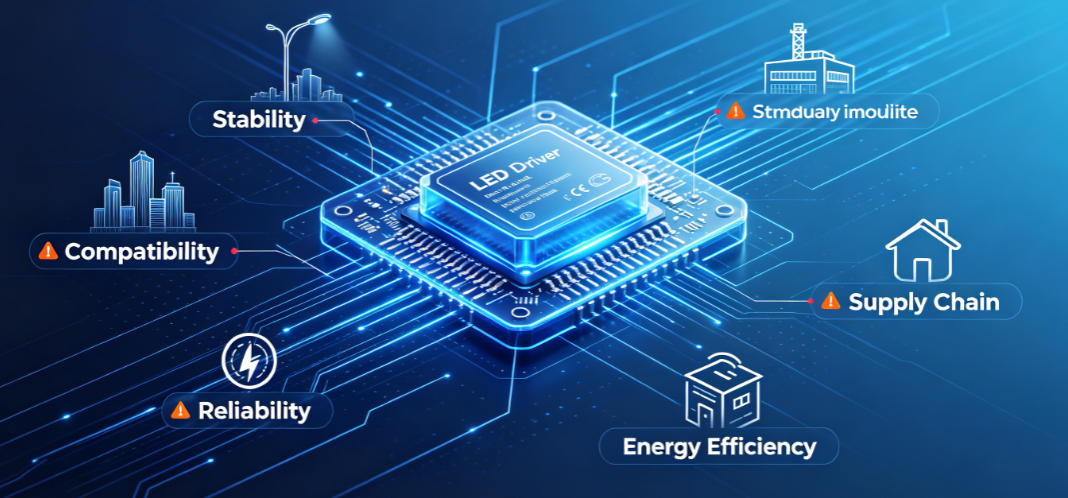
As global LED lighting infrastructure continues to penetrate and intelligent lighting upgrades accelerate, LED driver power supplies, as the core power guarantee of all lighting systems, play a decisive role in the stability, service life and comprehensive performance of lighting equipment. While the LED driver market maintains steady growth, the entire industry is also facing prominent technical, compatibility, environmental adaptation and supply chain pain points, which have become key bottlenecks restricting the high-quality development of the lighting industry.
The first prevalent industry pain point lies in insufficient operational stability and poor environmental adaptability. Statistics show that nearly 60% of LED lighting system failures in outdoor and industrial scenarios are caused by defective drivers. Most conventional LED drivers are sensitive to extreme temperatures, humidity and voltage fluctuations. High temperature working environments inside compact lamp fixtures will accelerate the aging of internal capacitors and electronic components. Typically, every 10°C increase beyond the rated temperature will halve the service life of electrolytic capacitors, resulting in frequent light flicker, abnormal light decay and early product failure. In addition, ordinary drivers lack complete lightning protection, moisture-proof and dust-proof mechanisms, and cannot adapt to harsh working conditions such as outdoor wind and rain exposure, high-temperature baking and low-temperature freezing, leading to high maintenance rates for engineering lighting projects.
Industry-wide compatibility and standardization chaos is another major challenge restricting industrial upgrading. The global LED driver market lacks unified universal technical standards. Different manufacturers adopt independent circuit designs, voltage specifications, current output protocols and dimming control methods including 0-10V, Triac, DALI and Bluetooth. The fragmented technical specifications lead to serious interoperability problems between drivers and lamps, intelligent control systems and legacy lighting infrastructure. Nearly 29% of lighting renovation and retrofit projects encounter equipment mismatch failures, which greatly increases project deployment difficulty, prolongs construction cycles, and raises the overall operation cost for end users and engineering contractors. At the same time, diversified customized demands force manufacturers to develop multiple product variants, further increasing R&D and production costs.
In terms of intelligent iteration and technical matching, the industry is facing obvious lagging development pressure. With the popularization of smart buildings, smart homes and urban smart lighting systems, lighting equipment has evolved from single lighting function to multi-scene intelligent control linkage. However, most traditional LED drivers can only meet basic constant-current and constant-power output functions, and cannot perfectly adapt to multi-protocol intelligent control systems. The incompatibility of intelligent communication interfaces and inconsistent dimming accuracy will cause system control failure, stroboscopic distortion and unsmooth scene switching, which cannot meet the high-precision and intelligent operation requirements of modern high-end lighting scenarios.
In addition, the LED driver industry is trapped in supply chain and cost stability pain points. Driver products rely heavily on core components such as special power semiconductors and electrolytic capacitors. Affected by global component supply fluctuations and raw material price volatility, manufacturing costs often fluctuate significantly year by year, bringing great uncertainty to enterprise procurement pricing and long-term order delivery. Meanwhile, increasingly stringent global energy efficiency and safety certification standards have raised higher thresholds for driver energy conversion efficiency, heat dissipation performance and safety protection. Many low-end and middle-end products in the industry are difficult to meet iterative regulatory requirements, resulting in market differentiation and elimination pressure.
To sum up, poor environmental stability, inconsistent industry standards, insufficient intelligent adaptation capability and unstable supply chain costs are the core common pain points of the current global LED driver power supply industry. Solving these industrial bottlenecks, promoting standardized, intelligent, high-efficiency and high-reliability iterative upgrading of driver products, has become the core direction of the sustainable and high-quality development of the entire LED lighting industry in the future.